

Information Disclosure Based on TCFD Recommendations
Endorsing and Addressing the TCFD Recommendations
In January 2020, NSK endorsed the Task Force on Climate-related Financial Disclosures (TCFD) recommendations. In accordance with the recommendations of the TCFD, NSK identifies business risks and opportunities, adapts management plans, and enhances information disclosure with the aim of contributing to both the sustainable development of society and the sustainable growth of NSK, while endeavoring to take its environmental activities to the next level.
Climate-related Governance
NSK has adopted a Company with Three Committees (Nomination, Audit, and Compensation) as its form of corporate organization. As part of this organization, the Board of Directors proactively delegates decisions regarding the execution of operations to the executive organizations and monitors the status of execution in an appropriate manner. Under the direction of the CEO, executive officers are responsible for executing their respective duties in accordance with their division of duties. The Mid-Term Management Plan, which sets out NSK’s strategies including climate change measures, is decided by the Board of Directors. The plan’s specific measures are implemented by the executive organizations, and the progress of these measures is reported to the Board of Directors on a regular basis (at least once a year) for monitoring.
Chaired by the CEO, the Sustainability & Core Values Committee specifies Group-wide issues by discussing policies for enhancing activities related to the core values of safety, quality, environment, and compliance, and through the sharing of climate-related risks. This Committee also provides suggestions for and monitors the progress of solutions to these issues.
Furthermore, in November 2021, NSK established the Carbon Neutrality Department to serve as an organization with the role of planning and implementing company-wide, cross-functional strategies designed to drive business growth by both decarbonizing business activities and contributing to the environment through products and services to help build a decarbonized broader society. We have continued to further strengthen the department’s activities.
Climate-related Risk Management
NSK works to build a risk management system based on clearly stipulated fundamental principles aimed at effectively enabling global Group management and internal control functions. Every year, NSK classifies, analyzes, and evaluates risks to identify the risks that should be addressed. These risks are then managed in accordance with the prescribed reporting systems.
NSK has for some time identified climate-related risk as a risk of high importance and has been addressing it across businesses and divisions. However, since 2021, NSK has been analyzing changes in the business environment and impacts on the Group’s business by making use of the scenario analysis recommended by the TCFD and has been enhancing efforts to identify issues and implement countermeasures, among other initiatives.
Strategy
With the goal of considering the impact that climate change will have on NSK’s value chain, as well as the effectiveness of climate change countermeasures, NSK looked at the period up to the year 2050 and performed two scenario analyses, one scenario with an average temperature increase of 1.5℃–2℃ above the pre-industrial level and another scenario with an increase of 4℃. As a result of these analyses, NSK determined that its basic strategy is to contribute to realizing a sustainable society in which the global temperature rise can be kept under 1.5℃–2℃.
In short, NSK acts to address transition risks associated with CO2 emission regulations and work to minimize these risks. Recognizing that meeting the needs of society for decarbonization throughout the product life cycle is an opportunity to grow its core business in Motion & Control™, NSK takes steps to address climate change through its overall business activities, including efforts to ensure alignment with the strategies of each department involved. Meanwhile, NSK also takes steps in consideration of the 4℃ scenario analysis results for natural disasters that are caused by climate change while identifying changes in climate patterns, such as frequency and impact of storm and flood damage in regions where its business sites are located.
Scenario Analysis
■ Analysis targets and prerequisites

■ Image of anticipated 2050 society in which NSK operates its business for the scenario analysis (outline)

Risks and Opportunities
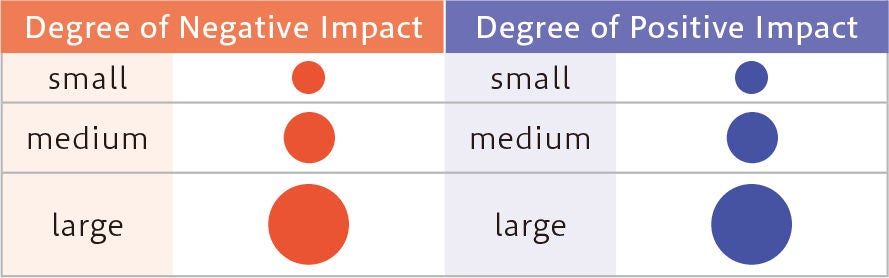
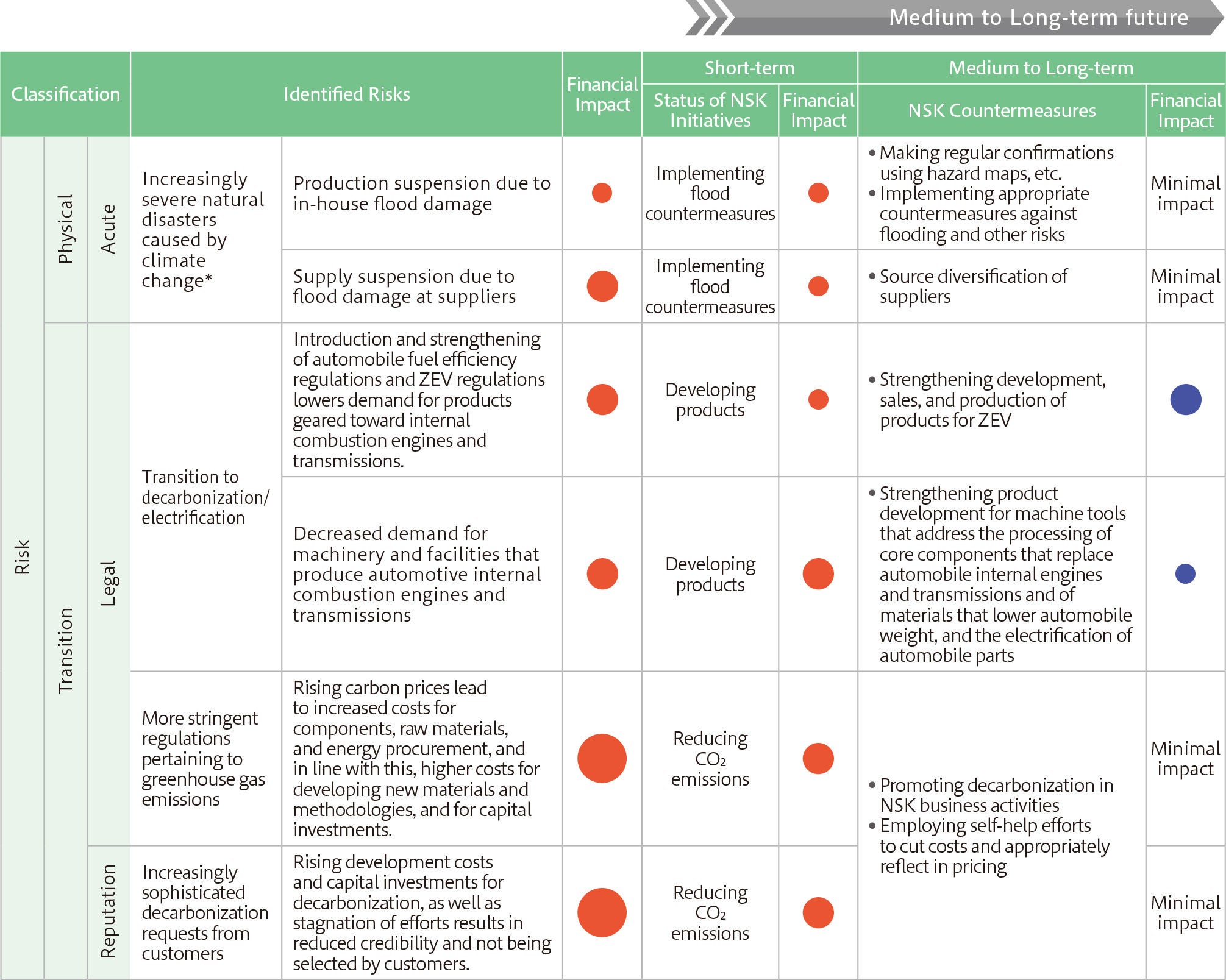
Financial impact is indicated as negative (red) or positive (blue) impact on the business, and the size of the circle indicates the scale of the impact.
When there is almost no impact, it is indicated as "Minimal impact."
Forecast of Risk from Response Measures
Opportunities
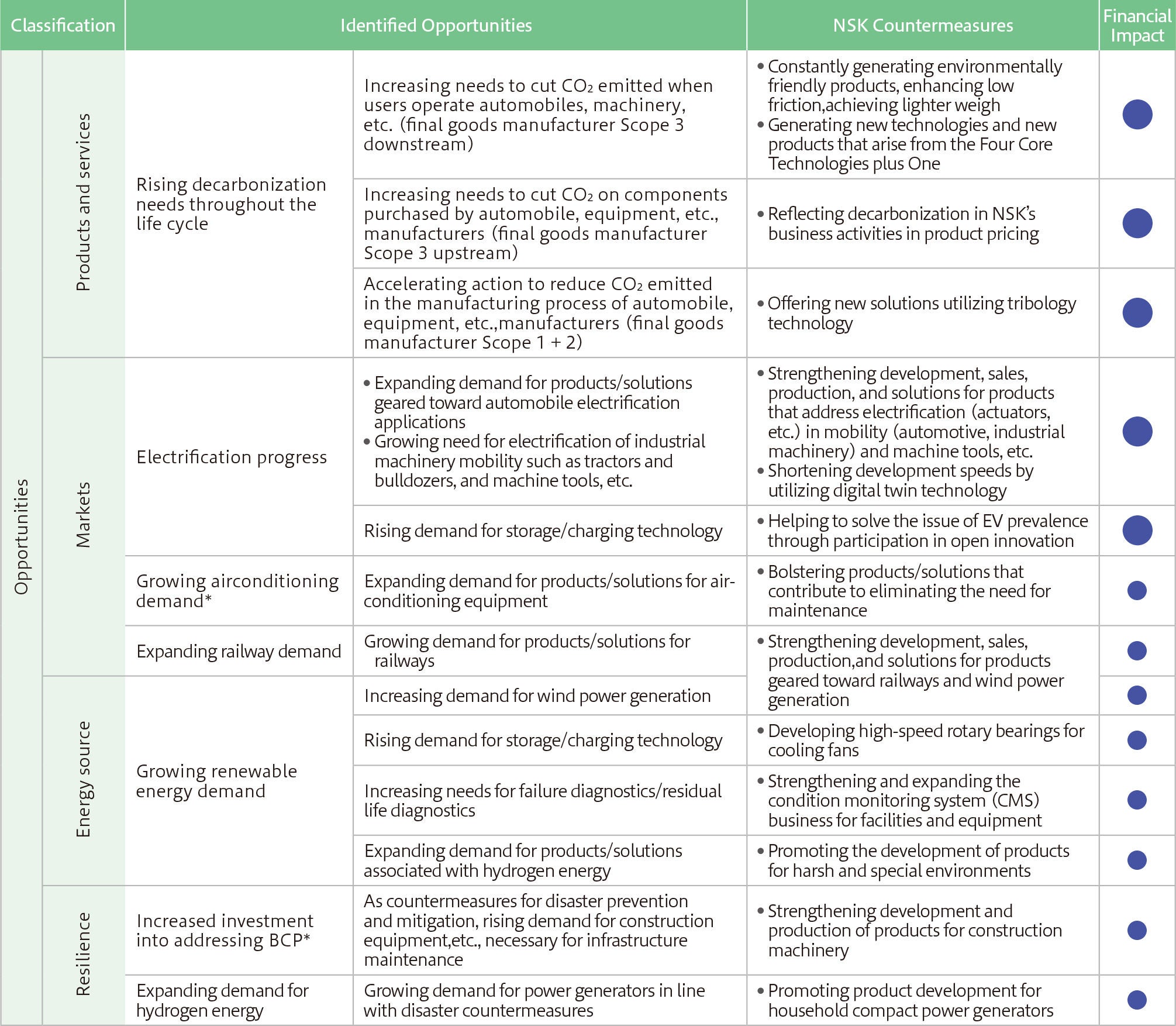
Created based on the 1.5℃ to 2℃ scenario. However, * is assumed to be for a 4℃ scenario.
In estimating the financial impact, the risk of inundation, the number of days of outages and damage due to inundation, and the projected carbon tax price are calculated using data published by public agencies.
Metrics and Targets
NSK has set long-term targets and is advancing initiatives through the dual approach of cutting CO2 emissions from business activities and expanding the volume of avoided emissions through the use of its environmentally friendly products.
NSK has been working on this in various ways, including by developing products that contribute to the advancement of the renewable energy industry and products that support the increasing electrification of vehicles, both of which are strategies in NSK’s industrial machinery and automotive businesses. In addition to these measures, in FY2022, NSK established a target of achieving carbon neutrality for Scope 1 and 2 CO2 emissions from the Group’s business activities by FY2035 under its Mid-Term Management Plan and has been working to strengthen these initiatives.
This CO2 emission reduction target is consistent with improving corporate value and is used as an indicator for executive officer short-term performance-based compensation.
FY2026 target (MTP2026): Reduce Scope 1 + 2 CO2 emissions by 50% vs FY2017
FY2028 target (MTP2028): Reduce Scope 1 + 2 CO2 emissions by 61% or more vs FY2017
FY2035 target: Achieve Scope 1 + 2 carbon neutrality